
Power Outage in Nigeria: How to Protect Your Appliances When Electricity Returns
Learn what can happen when electricity returns after a power outage in Nigeria, how to distinguish surges from voltage fluctuations, and practical ways to protect household and business appliances.
- Favour Otaigbe
- 16 min read
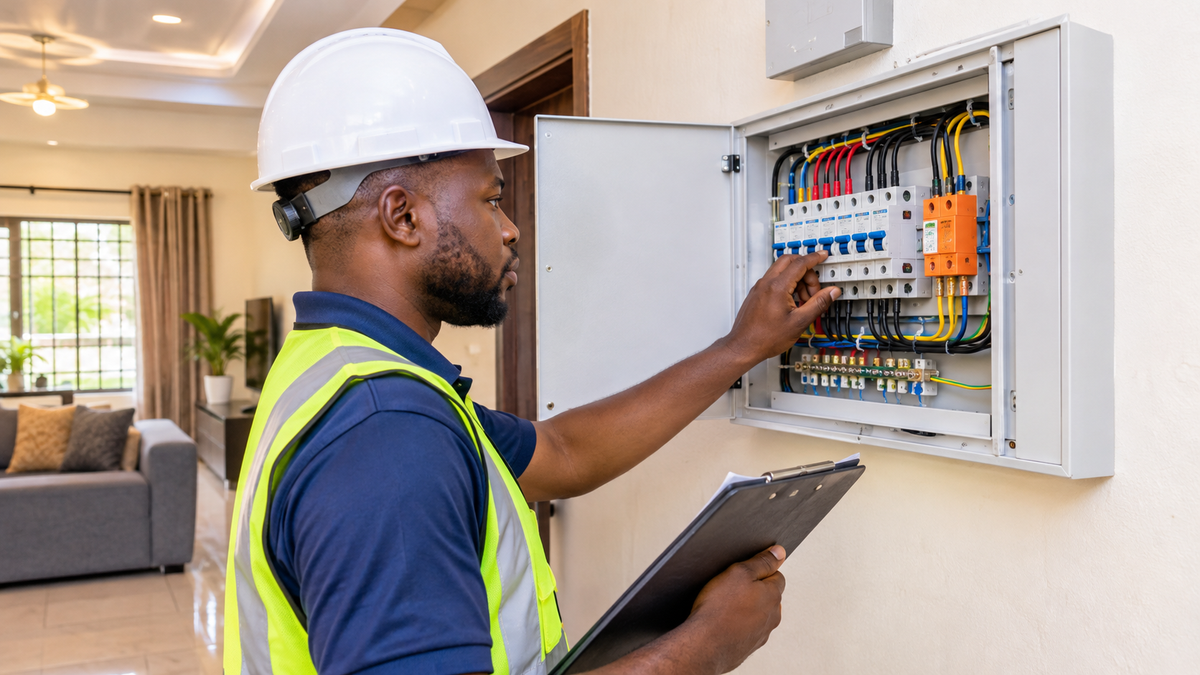
A power outage in Nigeria can interrupt more than your lighting and household appliances. When electricity returns, an electrical disturbance may also put sensitive equipment at risk.
Televisions, refrigerators, air conditioners, computers, CCTV recorders, inverters and other electronic devices contain components that can be affected by abnormal electrical conditions.
However, it is important to understand that not every power outage causes a damaging power surge. A brief voltage spike, a prolonged voltage fluctuation and a complete loss of electricity are different electrical events. Each requires a different form of protection.
In this guide, we explain what happens when electricity returns after an outage, how to protect your appliances, which protective devices are appropriate, and when to arrange a professional electrical inspection.
Whether you own a home, operate a shop or manage commercial premises in Benin City or elsewhere in Nigeria, these practical steps can help you make better electrical safety decisions.
1. Power Outage in Nigeria: What Happens When Electricity Returns?
A power outage occurs when the electricity supply to a property is interrupted.
The interruption may originate from electricity generation, transmission, distribution equipment, planned maintenance or a fault within the property's own electrical installation.
When supply is restored, the electrical conditions should be checked rather than assuming everything is immediately normal.
There are several electrical events that property owners should understand.
Electrical event | What it means | Appropriate response |
|---|---|---|
Power outage | Electricity supply is interrupted | Suitable backup power if required |
Transient voltage surge | A very brief increase in voltage | Properly selected surge protective device |
Undervoltage | Supply voltage remains below the expected level | Appropriate voltage monitoring or regulation and investigation |
Sustained overvoltage | Supply voltage remains excessively high | Appropriate voltage protection and fault investigation |
Circuit overload | Equipment draws more current than the circuit can safely carry | Correct circuit protection and load assessment |
Short circuit | Electricity takes an unintended low-resistance path | Fault isolation and professional repair |
These conditions should not be treated as interchangeable.
For example, a surge protective device (SPD) is designed to limit transient overvoltages. It does not automatically correct a prolonged low-voltage supply or provide backup electricity.
Understanding the difference prevents unnecessary equipment purchases and helps ensure that your property receives the correct protection.
2. Why Can Power Surges Happen When Electricity Returns?
A power surge is a short-duration electrical disturbance that raises voltage above its normal level.
It is also known as a transient overvoltage.
Several conditions can produce these disturbances.
A. Lightning activity
Lightning can introduce transient voltage disturbances into nearby electricity and communication lines.
Even when lightning does not directly strike a building, an indirect disturbance can travel through connected infrastructure and potentially affect electrical equipment.
This is one reason why surge protection should be considered as part of a property's wider electrical protection arrangement.
B. Switching operations on electricity networks
Switching operations involving electrical networks, transformers and other equipment can produce transient disturbances.
These events are not necessarily visible to property owners, but sensitive electronic equipment may be affected.
C. Switching large electrical appliances
Certain appliances generate electrical disturbances when their motors or compressors start and stop.
Examples include:
Air conditioners.
Refrigerators and deep freezers.
Borehole and water pumps.
Industrial motors.
Some electrical machinery.
These disturbances may originate inside the property rather than from the public electricity supply.
D. Internal electrical faults
Damaged wiring, deteriorated connections and other installation problems can contribute to abnormal electrical conditions.
An electrical installation with neglected maintenance should be inspected rather than relying entirely on plug-in protective devices.
The IET explains the different causes of transient overvoltages, including lightning and the switching of motors and transformers.
Reference: IET Surge Protective Devices.
3. Which Appliances Are Vulnerable to Electrical Surges?
Modern appliances contain electronic components that can be sensitive to abnormal electrical conditions.
The risk depends on the equipment, the nature of the disturbance and the protection already installed.
Common household appliances
Some examples include:
Smart televisions.
Desktop computers and laptops.
Routers and electronic communication equipment.
Refrigerators and deep freezers.
Air conditioners.
Washing machines.
Microwave ovens.
Electronic kitchen appliances.
Solar and inverter equipment
Solar installations also contain sensitive electronic components.
These may include:
Solar inverters.
Battery management systems (BMS).
Charge controllers.
Monitoring equipment.
Electronic control boards.
A solar installation should therefore have protection appropriate to its particular electrical configuration.
CCTV and security equipment
Properties with security installations should also consider:
Digital Video Recorders (DVRs).
Network Video Recorders (NVRs).
CCTV cameras.
Camera power supplies.
Access-control equipment.
Alarm control panels.
A failed recorder or camera power supply can interrupt surveillance even when the rest of the building still has electricity.
For commercial properties, protecting security equipment is especially important because equipment failure can affect monitoring and recording continuity.
4. What Should You Do Before and During a Power Outage?
You cannot always predict when electricity will go off. However, a few precautions can reduce unnecessary exposure.
Step 1: Switch off appliances that should not restart automatically
Switch off equipment such as:
Electric irons.
Electric cookers.
Water heaters.
Hair straighteners.
Other heating appliances.
This helps prevent appliances from operating unexpectedly when power returns.
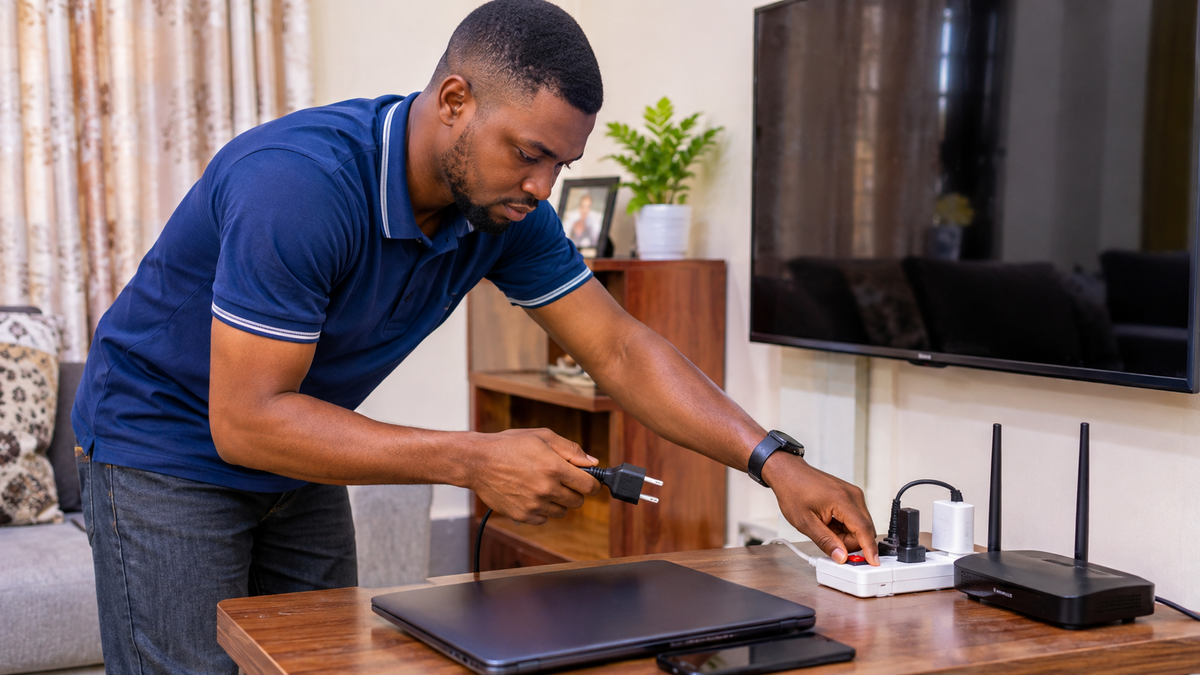
Step 2: Disconnect sensitive electronics where safe
During an extended outage, consider unplugging sensitive equipment such as televisions, computers and other valuable electronic devices.
Only do this where the socket and plug are safe, dry and undamaged.
Step 3: Protect your electrical installation
Do not attempt to open your distribution board, remove meter seals or investigate incoming supply cables during an outage.
Leave electrical inspection and repairs to a competent professional.
Step 4: Consider your backup power arrangements
If your property has an inverter, solar system or generator, make sure the changeover arrangement is suitable for the installation.
A backup system should be connected and protected correctly.
It should never be improvised by joining generator, inverter and public supply conductors together.
5. What Should You Do When Electricity Returns?
When electricity returns after an outage, avoid switching on every appliance immediately.
Follow these practical steps.
Step 1: Observe the returning supply
Check whether your lighting and other electrical equipment appear to be operating normally.
Watch out for:
Unusually bright lights.
Repeated flickering.
Lights becoming unusually dim.
Electricity switching on and off repeatedly.
Unusual buzzing from electrical equipment.
These symptoms do not prove a surge has occurred, but they may indicate an electrical problem that needs attention.
Step 2: Keep sensitive appliances disconnected if supply is unstable
Where the supply continues to fluctuate, keep sensitive electronics switched off or disconnected until the problem has been investigated.
Do not repeatedly reconnect appliances during unstable supply conditions.
Step 3: Restore appliances gradually
Once the supply appears stable, reconnect and switch on appliances gradually.
Follow the manufacturer's instructions for equipment that requires a restart delay, particularly compressors and other motor-driven appliances.
Step 4: Check for abnormal behaviour
Watch for:
Burning smells.
Unusual heat around plugs or sockets.
Buzzing or crackling sounds.
Repeated breaker trips.
Appliances refusing to operate.
Electronic devices displaying error messages.
Do not continue using an appliance that appears damaged.
Step 5: Contact the right service provider
If an entire neighbourhood is affected, report the interruption to your electricity distribution company.
If neighbouring properties have electricity but your building does not, the problem may involve your service connection, meter, protective equipment or internal installation.
A qualified electrician can inspect the customer-side installation.
If you are experiencing meter-related issues, read our guide on Prepaid Electricity Meter Problems in Nigeria for common causes, safe checks and guidance on when to contact your electricity provider.
6. Which Devices Protect Your Appliances?
Different protective devices perform different functions.
Purchasing one device does not automatically protect a building against every electrical problem.
Device | Main purpose | What it does not replace |
|---|---|---|
Surge Protective Device (SPD) | Limits transient overvoltage | Backup power or continuous voltage regulation |
Voltage regulator (AVR) | Regulates certain voltage variations within its operating range | Proper surge protection or fault repair |
UPS | Provides temporary backup power | A correctly designed whole-installation SPD |
Inverter and battery system | Provides alternative or backup electricity | Correct AC/DC surge protection |
Circuit breaker (MCB) | Protects against specified overload and short-circuit conditions | Surge protection |
RCCB/RCD | Provides residual-current protection | Overcurrent or transient surge protection |
Earthing and bonding | Supports electrical safety and protective-device operation | The protective devices themselves |
A. Surge Protective Device (SPD)
An SPD is designed to limit transient overvoltages and help protect connected equipment and the electrical installation.
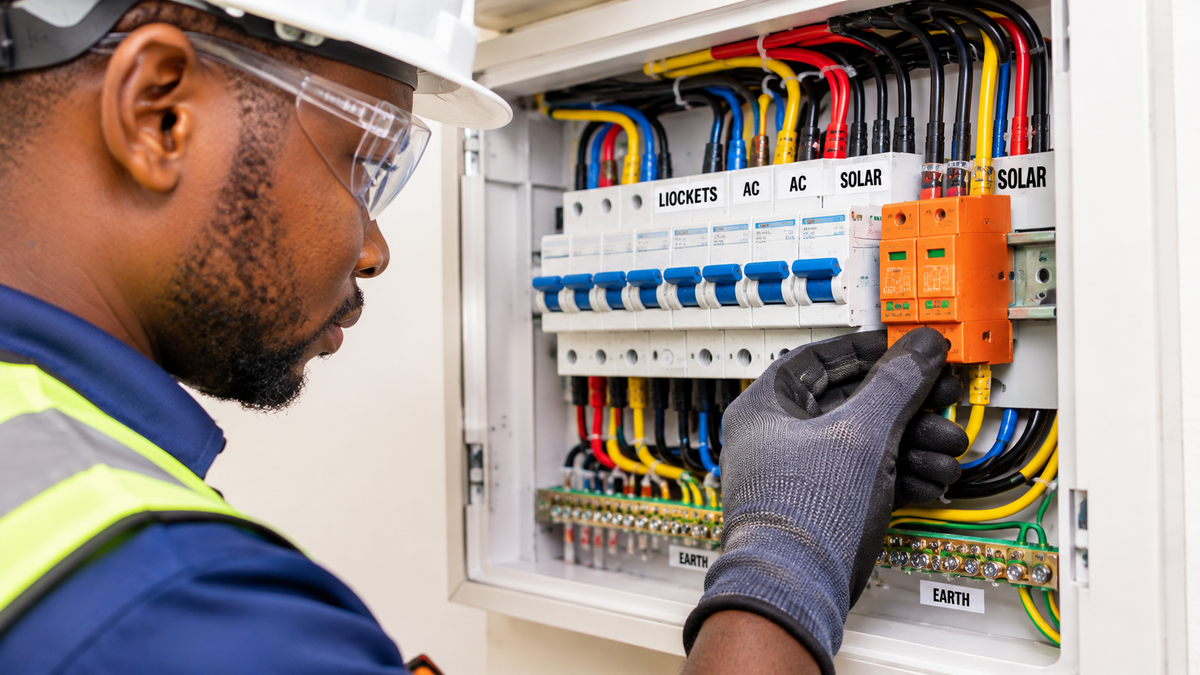
Depending on the installation design, it may be installed within the main distribution board or at another appropriate point.
The correct device must be selected for the electrical installation and coordinated with other protective equipment.
B. Automatic Voltage Regulator (AVR)
A voltage regulator is used to manage certain sustained voltage variations.
For example, some regulators are designed to protect connected equipment against brownouts and overvoltage conditions within their specified operating limits.
A voltage regulator and an SPD have different functions.
Installing an AVR does not mean that the property has comprehensive transient surge protection.
See Schneider Electric Nigeria's surge protection and power conditioning range for examples of these separate product categories.
C. Uninterruptible Power Supply (UPS)
A UPS provides temporary electrical backup when the main supply fails.
It is commonly used for:
Computers.
Point-of-sale equipment.
Routers.
Servers.
Electronic control equipment.
Some UPS products include surge protection, but the level of protection depends on the particular model.
Check the manufacturer's specifications instead of assuming that every UPS provides the same protection.
D. Inverter and battery systems
An inverter system provides alternative electricity during an outage when properly designed and installed.
However, an inverter should not automatically be treated as a complete surge protection solution.
Its internal protective functions, external protection requirements and compatibility with the electrical installation must be assessed.
E. Circuit breakers and residual-current protection
Circuit breakers help protect circuits against specified overcurrent conditions, including overloads and short circuits.
Residual-current devices provide another form of electrical protection by responding to certain leakage-current conditions.
These devices are important, but they do not perform the same function as an SPD.
7. Types of Surge Protective Devices
Surge protective devices are commonly classified into three types.
The IET provides the following general descriptions.
Type 1 SPD
A Type 1 SPD is installed at the origin of an electrical installation, such as the main distribution board, where the system design calls for this type of protection.
It is intended for installations requiring protection against higher-energy surge currents.
Type 2 SPD
A Type 2 SPD is commonly installed at a distribution board or sub-distribution board.
It provides another level of protection against transient overvoltages within the installation.
Type 3 SPD
A Type 3 SPD is installed close to the equipment requiring additional protection.
Examples may include sensitive computers, televisions and other electronic equipment.
Important: Type 3 devices are supplementary protection. They should not be treated as a standalone replacement for an appropriately designed upstream SPD arrangement.
Where multiple SPDs are installed, their characteristics and operation must be coordinated.
The correct arrangement depends on the building, the supply system, equipment specifications and installation design.
Reference: IET — Surge Protective Devices.
8. Why Proper Earthing Matters for Surge Protection
Earthing is an important part of an electrical installation's protective arrangement.
Depending on the type of SPD and electrical system, the device may use the earthing arrangement to divert surge current away from protected equipment.
Poor earthing, incorrect connections or an unsuitable protective arrangement can compromise the overall performance and safety of the installation.
A professional assessment should consider:
The existing earthing arrangement.
Protective bonding.
Main distribution board connections.
Neutral and protective conductors.
SPD compatibility.
Protective-device coordination.
Manufacturer installation instructions.
The objective is not simply to install an SPD. It is to ensure that the complete electrical protection arrangement is suitable.
9. Surge Protection for Solar, Inverter and Generator Installations
Properties using multiple power sources need particular attention.
A building may receive electricity from:
Public electricity supply.
A petrol or diesel generator.
A solar installation.
An inverter and battery system.
The different sources and changeover arrangements must be considered when designing electrical protection.
Solar installations
Solar systems may require appropriate protection on relevant AC and DC circuits.
The protection selected for a photovoltaic array must be suitable for the DC characteristics and maximum voltage of the actual solar installation.
The inverter's AC connections also require consideration within the building's protective arrangement.
Do not install an ordinary AC surge device on a solar DC circuit simply because its rating appears similar.
Inverter installations
The protection requirements depend on the inverter model and the arrangement of the existing electrical installation.
The installer should consider:
Inverter input and output.
Battery specifications.
AC distribution.
Existing earthing.
Changeover arrangement.
Manufacturer-recommended protective devices.
Generator installations
A generator installation should have an appropriate transfer or changeover arrangement.
The electrical installation should prevent unsafe interconnection or unintended backfeeding into the public network.
Generator earthing, neutral arrangements and protective equipment must be assessed as part of the complete installation.
For a broader comparison of backup-power choices, see our article on Solar vs Generator in Nigeria.
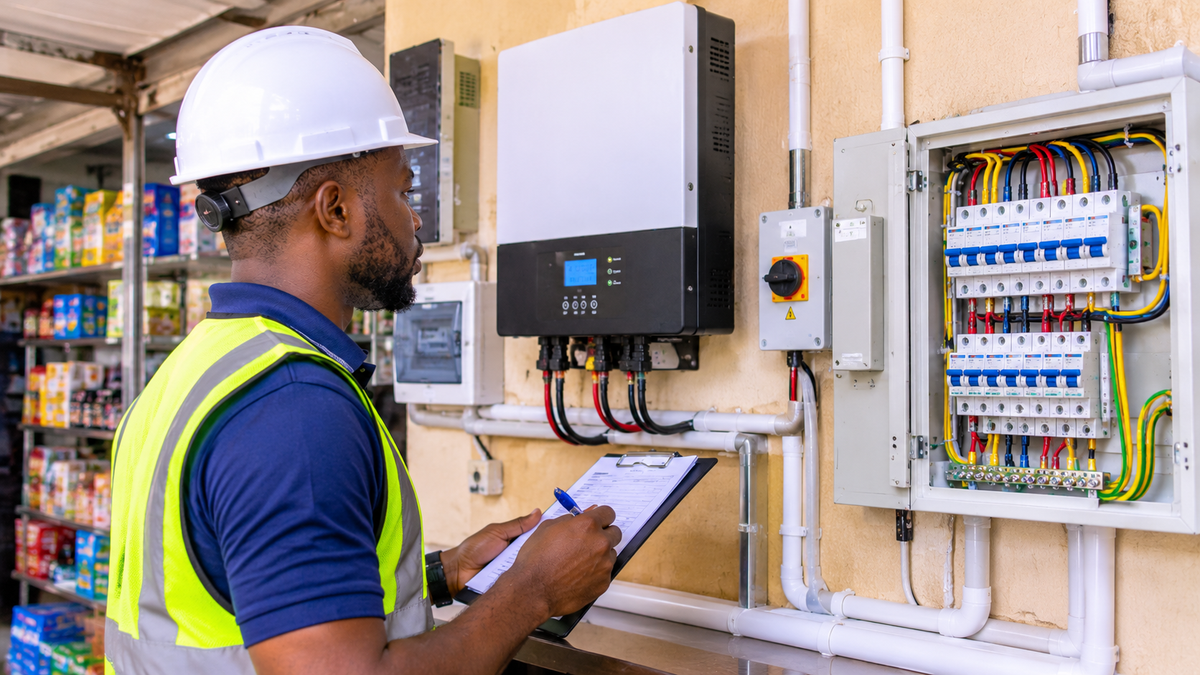
10. How Can Businesses Protect Their Electrical Equipment?
Commercial premises can face additional losses when electrical disturbances damage equipment or interrupt operations.
For example, a shop may depend on:
Refrigerators and deep freezers.
POS terminals.
Computers.
CCTV surveillance systems.
Office equipment.
Electronic access-control systems.
A business should identify which equipment is essential and determine the most suitable way to protect it.
Create a protection plan
A useful starting point is to separate critical equipment from non-essential loads.
For example:
Business equipment | Protection consideration |
|---|---|
CCTV recorder and cameras | Suitable power protection and backup where needed |
POS terminals | Compatible UPS and surge protection |
Computers | Suitable UPS and surge protection |
Refrigerators and freezers | Correctly rated electrical supply and appropriate motor protection |
Office lighting | Proper circuit protection |
Solar inverter | Compatible AC/DC protection and installation checks |
The arrangement should be designed around the actual equipment and the property's electrical requirements.
A properly designed installation helps reduce avoidable equipment failures and downtime.
11. Signs Your Property Needs an Electrical Inspection
Consider arranging a professional inspection when you notice any of the following:
Lights repeatedly flicker when electricity returns.
Electrical appliances begin failing unexpectedly.
Circuit breakers trip repeatedly.
Sockets or plugs become unusually hot.
You notice burning smells or unusual electrical sounds.
Your distribution board has visibly damaged components.
Your SPD protection-status indicator shows a fault.
Your inverter or solar system repeatedly reports electrical warnings.
These symptoms do not automatically establish that a surge caused the problem.
They indicate that the installation or affected equipment may need investigation.
For example, a repeatedly tripping breaker may be related to overload, short circuit, leakage current or another electrical fault.
Our article, Why Does Your Circuit Breaker Keep Tripping?, explains common causes and safe next steps.
12. What Should a Professional Surge Protection Assessment Include?
Before recommending equipment, an electrician should understand the existing installation.
A proper assessment should consider:
A. Incoming electrical supply
The electrician should identify the supply characteristics and the electrical arrangement serving the building.
B. Existing distribution board
The main distribution board should be assessed for its condition, protective equipment, available space and suitability for the proposed protection.
C. Earthing and bonding
The existing earthing arrangement should be checked for suitability and compliance with applicable requirements.
D. Connected equipment
The appliances and equipment requiring protection should be identified.
This is particularly important where there are sensitive electronics, refrigeration equipment, CCTV systems or commercial machinery.
E. Surge protection selection
The installer should identify an appropriate SPD type, rating and installation arrangement based on the assessed system and manufacturer's technical specifications.
F. Installation and testing
The device should be installed according to the manufacturer's instructions, including connection arrangements and required protective components.
The installer should verify the completed work and explain the device's protection-status indicators and maintenance requirements.
G. Backup power integration
Where a solar system, inverter or generator is installed, its arrangement should be considered before completing the protection design.
The objective is to protect the installation as a complete system rather than adding an isolated device without checking compatibility.
Need an electrician to check your installation?
If your appliances are affected by voltage fluctuations, your distribution board needs attention or you want to discuss suitable surge protection, BrightForge can assess your electrical installation.
We serve homes and businesses in Benin City, Edo State, and consider suitable project enquiries from elsewhere in Nigeria.
13. Frequently Asked Questions
Does every power outage cause a power surge?
No. A power outage is an interruption of electricity supply. A surge is a brief increase in voltage. A transient disturbance may occur during switching or restoration, but every power interruption does not automatically produce a damaging surge.
What is the difference between a surge protector and a voltage regulator?
A surge protector limits brief transient voltage disturbances. A voltage regulator manages certain longer-lasting voltage variations within its operating range. They perform different functions and may both be required depending on the installation.
Can an inverter protect my appliances from power surges?
Not automatically. Some inverters contain protective features, but their capabilities vary by model. The actual surge protection requirements must be checked against the inverter specifications and the building's electrical installation.
Is a normal extension box enough to protect my television and computer?
Not necessarily. A multi-socket extension box is not automatically a surge protector. Check the manufacturer's specifications for genuine surge protection and use it as part of an appropriately designed protective arrangement.
When should I contact an electrician after electricity returns?
Arrange an inspection when appliances fail, lights flicker repeatedly, breakers trip, sockets become unusually hot or you notice burning smells or unusual electrical sounds. Do not keep using damaged equipment or repeatedly resetting a tripping breaker.
Conclusion: Protect Your Electrical Installation Before Problems Occur
Power interruptions are frustrating, but the risks to your property are not limited to the period when electricity is unavailable.
Transient surges, sustained voltage abnormalities, poor earthing, faulty wiring and incorrectly selected protective equipment can all affect the safety and reliability of an electrical installation.
The most effective approach is to understand the electrical problem, select suitable protective devices and ensure that the installation is properly assessed and maintained.
Do not rely on a single cheap surge strip or assume that an inverter, generator or circuit breaker protects against every electrical disturbance.
A properly designed electrical protection arrangement helps safeguard appliances, electronic equipment and the wider installation.
BrightForge Electrical & Security Ltd provides electrical repairs and maintenance, electrical wiring and installation, and solar installation services for residential and commercial properties in Benin City, Edo State, and suitable projects elsewhere in Nigeria.
Have you experienced repeated voltage fluctuations, damaged appliances or electrical problems after power restoration?
Contact BrightForge to discuss your requirements and request a professional electrical assessment.
Need help with this at your property?
Tell us what you need and we'll get back to you during business hours. (Monday–Saturday, 8:00 AM–6:00 PM)