Electrical Projects & Planning
Solar vs Generator in Nigeria (2026): Which Is Cheaper?
Solar vs generator in Nigeria: compare fuel, electricity bills, maintenance, batteries and installation costs to find the most cost-effective option for your home.
- Favour Otaigbe
- Updated
- 10 min read
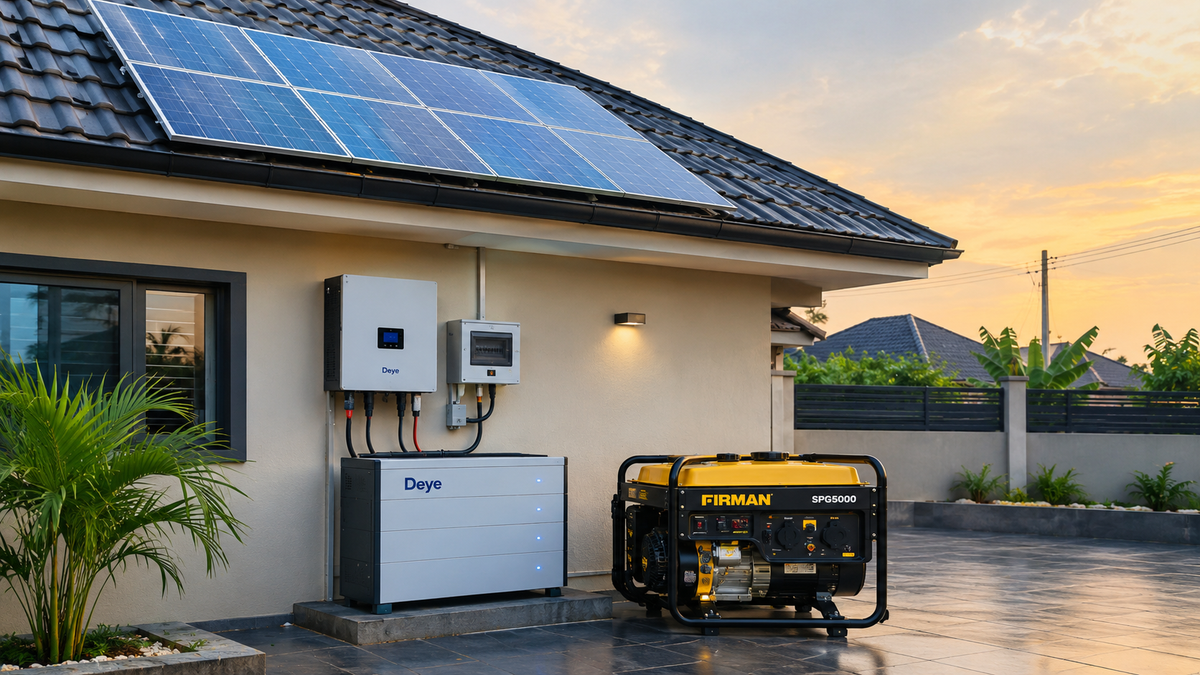
For many Nigerian households, electricity costs do not end with the monthly electricity bill or prepaid meter tokens. When grid supply fails, there is often another expense: petrol or diesel for a generator.
Solar power offers an alternative, but installing a solar system requires an upfront investment in panels, an inverter, batteries and installation. So, which option actually saves more money in 2026?
The answer depends on your electricity consumption, power supply, generator fuel usage, solar system size and how long you intend to use the system.
In this guide, we compare solar, generators and grid electricity to help you make a more informed decision.
1. Solar vs Generator: What Is the Main Difference?
A generator produces electricity by burning fuel. You pay for fuel whenever it runs, in addition to maintenance, servicing and eventual replacement.
A solar system converts sunlight into electricity. Depending on its design, it can power your appliances during daylight and store surplus energy in batteries for use at night or when grid electricity is unavailable.
The main financial difference is simple:
Generator: Generally cheaper to purchase initially, but requires ongoing fuel and maintenance expenditure.
Solar: Usually requires a higher initial investment, but does not require petrol or diesel to generate electricity.
Grid electricity: Can be cheaper per unit of electricity, but its value depends on the tariff you pay and the reliability of your supply.
Solar systems still have running costs, and batteries may eventually need replacement. Therefore, comparing purchase prices alone will not give you the full picture.
2. How Much Does Generator Electricity Really Cost?
The cost of running a generator involves more than the price of petrol or diesel.
Consider these expenses:
Fuel consumed during operation.
Engine oil, servicing and repairs.
Replacement parts and eventual generator replacement.
The inconvenience of refuelling and the noise produced during operation.
Your actual cost depends on the generator's fuel consumption and the electrical load connected to it.
For example, a generator powering a few lights and fans may use fuel differently from one powering a refrigerator, freezer, television and air conditioner.
How to calculate your generator's fuel cost
Use this simple formula:
Daily fuel cost = Litres of fuel used per day × Current price per litre
For example, if your generator consumes 2 litres daily and petrol costs ₦1,200 per litre, the daily fuel expenditure would be:
2 litres × ₦1,200 = ₦2,400.
Over 30 days, that becomes ₦72,000, excluding maintenance and repairs.
This is an illustration, not a current petrol-price quotation. Replace the example price and fuel consumption with your actual figures.
The National Bureau of Statistics publishes petrol and diesel price reports that can help you understand changes in fuel prices across Nigeria.
3. How Much Does Solar Power Cost?
A solar installation's cost depends on the equipment required and the complexity of the installation.
The main components are:
Solar panels to generate electricity.
An inverter to convert electricity into a form suitable for your appliances.
Batteries to store electricity for later use, where storage is required.
Mounting structures, cables, protective devices and earthing.
Installation, testing and commissioning.
A small system designed for lighting, fans, television and phone charging will have different requirements from a system expected to operate refrigerators, freezers or air conditioners.
This is why choosing a solar system solely because it has a particular inverter rating can lead to disappointment. The inverter, solar panels and battery must be suitable for your actual loads and expected usage.
Does solar have maintenance costs?
Yes, although it does not require generator fuel.
Solar panels need occasional cleaning and inspection. Electrical connections, protective devices, inverters and batteries also require appropriate maintenance.
Battery replacement is an important long-term expense. Battery life depends on the battery chemistry, operating temperature, charging conditions, depth of discharge and usage patterns.
A realistic comparison should account for these costs rather than treating solar electricity as completely free.
4. Is Solar Cheaper Than a Generator in Nigeria?
Solar can be more economical over time, particularly for households that spend heavily on generator fuel. However, it is not automatically the cheapest option for every household.
Three factors matter most.
A. How often do you run your generator?
If your generator runs for several hours every day, fuel expenditure can accumulate quickly. Replacing some of those operating hours with solar-generated electricity may reduce your running costs.
If your generator runs only occasionally, the savings may not justify a large solar investment as quickly.
B. How reliable is your grid electricity?
Your electricity tariff and the number of hours you receive supply both matter.
A household with relatively reliable grid electricity may have less financial incentive to purchase a large solar system purely to reduce its electricity bill.
A household experiencing frequent outages may spend considerably more on alternative power and could benefit more from a properly sized solar installation.
C. How much does the solar system cost?
A solar system should be compared with the generator expenditure it can realistically replace.
If a system is expensive relative to your existing fuel costs, the financial payback may take longer. If it replaces substantial fuel consumption, the savings may be greater.
There is no universal payback period that applies to every Nigerian home.
5. Solar vs Generator vs Grid Electricity
Factor | Solar | Generator | Grid electricity |
|---|---|---|---|
Initial cost | Usually high | Usually lower | Connection and metering costs may apply |
Fuel expenditure | None for sunlight | Ongoing | None for the customer |
Running costs | Maintenance and possible battery replacement | Fuel and maintenance | Depends on consumption and tariff |
Noise | Generally quiet | Produces noise | No generator noise at the point of use |
Power availability | Depends on system design, sunlight and battery capacity | Depends on fuel and generator condition | Depends on grid supply |
Best use | Reducing dependence on other power sources | Backup during outages | Everyday power when supply is available |
These options do not have to be mutually exclusive. Many households can use grid electricity when available, solar and batteries for suitable loads, and a generator when extended outages or unusually high loads require it.
6. How to Calculate Whether Solar Will Save You Money
Before purchasing a system, calculate what you currently spend on electricity and alternative power.
Step 1: Record your monthly electricity expenses
Add your average monthly prepaid meter expenditure to your generator fuel and maintenance costs.
Keep these amounts separate initially so that you can identify where most of your money goes.
Step 2: Estimate the generator costs solar could replace
Do not assume that solar will eliminate every generator expense. Identify the appliances and operating hours the proposed solar system can realistically cover.
Step 3: Obtain a properly sized solar quotation
Ask for a quotation that identifies the solar panels, inverter, battery capacity, protective devices, installation costs and applicable warranties.
The design should reflect your actual appliances, starting currents, daily energy consumption and required backup duration.
Step 4: Include long-term costs
Allow for maintenance and the possibility of battery replacement during the period you intend to use the system.
Step 5: Estimate the payback period
A simplified calculation is:
Payback period = Initial solar investment ÷ Monthly net savings
For instance, if a solar installation costs ₦3,000,000 and genuinely reduces your total monthly electricity expenditure by ₦50,000, the simple payback period is 60 months, or five years.
This is an illustrative calculation, not a prediction or quotation. It assumes the monthly savings remain constant and excludes financing costs, future repairs, battery replacement and changes in energy prices. Actual savings may differ considerably.
7. Should You Buy Solar or Keep Your Generator?
Consider these practical guidelines.
Solar may be worth considering if:
You spend substantial amounts on generator fuel.
Your household experiences frequent power outages.
You need quieter power for working, studying or sleeping.
Your electricity needs can be met by a sensibly sized system.
You can afford the initial investment without taking on unsuitable debt.
Keeping your generator may make more sense for now if:
You receive reliable grid electricity most of the time.
Your generator is used only occasionally.
Your available budget cannot cover a properly designed solar system.
You need to save for an installation that can safely handle your appliances.
You can also consider a phased approach, beginning with essential loads such as lighting, fans, television, routers and phone charging before expanding the system when your budget and energy needs allow.
Avoid buying an undersized system simply because it is cheaper. It may not deliver the performance you expect.
8. What Should You Check Before Installing Solar?
Before committing to an installation, confirm the following:
Load assessment: Have your appliances and daily energy requirements assessed.
Battery capacity: Ensure the battery can support the loads for your required backup period.
Solar panel capacity: Account for expected energy consumption, sunlight conditions and system losses.
Electrical protection: Confirm that suitable breakers, isolators, surge protection and earthing are included where required.
Installation quality: Check cable sizing, connections, mounting and commissioning.
Warranty and support: Understand the manufacturer's warranty, installation workmanship terms and maintenance requirements.
Written quotation: Ensure the equipment specifications, labour, exclusions and payment terms are clearly stated.
A professionally designed installation should be based on your requirements rather than a one-size-fits-all package.
Frequently Asked Questions
Is solar cheaper than a generator in Nigeria in 2026?
It can be cheaper over time when the savings from displaced generator fuel and maintenance outweigh the solar system's initial and long-term costs. Your fuel consumption, grid supply, system price and usage determine the outcome.
Can solar power run an air conditioner?
Yes, if the solar installation is properly designed for the air conditioner's running consumption, starting requirements where applicable, other connected loads and intended operating hours. Battery and panel capacity are particularly important.
Can I use solar and a generator together?
Yes. A properly designed hybrid system can work alongside grid electricity and a generator, depending on the equipment and installation design.
Do solar panels work when there is no sunlight?
Solar panels generate electricity from available sunlight, so their output decreases in poor weather and they do not generate meaningful power at night. Batteries can supply stored energy when sunlight is unavailable, provided sufficient energy has been stored.
What is the best solar system for a Nigerian home?
There is no single best system for every home. The appropriate design depends on appliance loads, daily energy use, backup requirements, available budget and future plans.
Final Verdict: Which Option Is Better?
Solar, generators and grid electricity each serve different needs.
Grid electricity can be economical when supply is reliable. Generators provide a familiar backup option but involve recurring fuel and maintenance costs. Solar requires a larger initial investment, but it can reduce dependence on fuel and improve access to electricity during outages.
The smartest decision is to calculate your existing electricity expenditure, assess your actual loads and compare them with a properly designed solar installation.
Do not buy solar simply because it is popular. Choose it when the system meets your needs, fits your budget and offers a reasonable long-term benefit.
Need Help Planning a Solar Installation?
BrightForge Electrical & Security Ltd provides solar installation services in Benin City, Edo State.
If you are considering solar for your home or business, start with a proper assessment of your appliances, electricity consumption and backup requirements.
Request a solar installation quotation: https://brightforge.ng/quote
Learn more about our services: https://brightforge.ng/services
Disclaimer: This article provides general educational information, not a guaranteed savings estimate. Fuel prices, electricity tariffs, equipment costs and system performance vary. Obtain a site assessment and a written quotation before making an installation decision.
References
National Bureau of Statistics (NBS): Petrol Price Watch
Nigerian Electricity Regulatory Commission (NERC): Electricity tariff orders
International Energy Agency (IEA): Electricity 2026
Need help with this at your property?
Tell us what you need and we'll get back to you during business hours. (Monday–Saturday, 8:00 AM–6:00 PM)