How Much Does Solar Installation Cost in Nigeria in 2026? A Practical Guide for Homes and Businesses
Planning to install solar in Nigeria? Discover indicative 2026 installation costs for different system sizes, what affects your final budget, and how to choose the right solar setup for your home or business.
- Favour Otaigbe
- Updated
- 14 min read
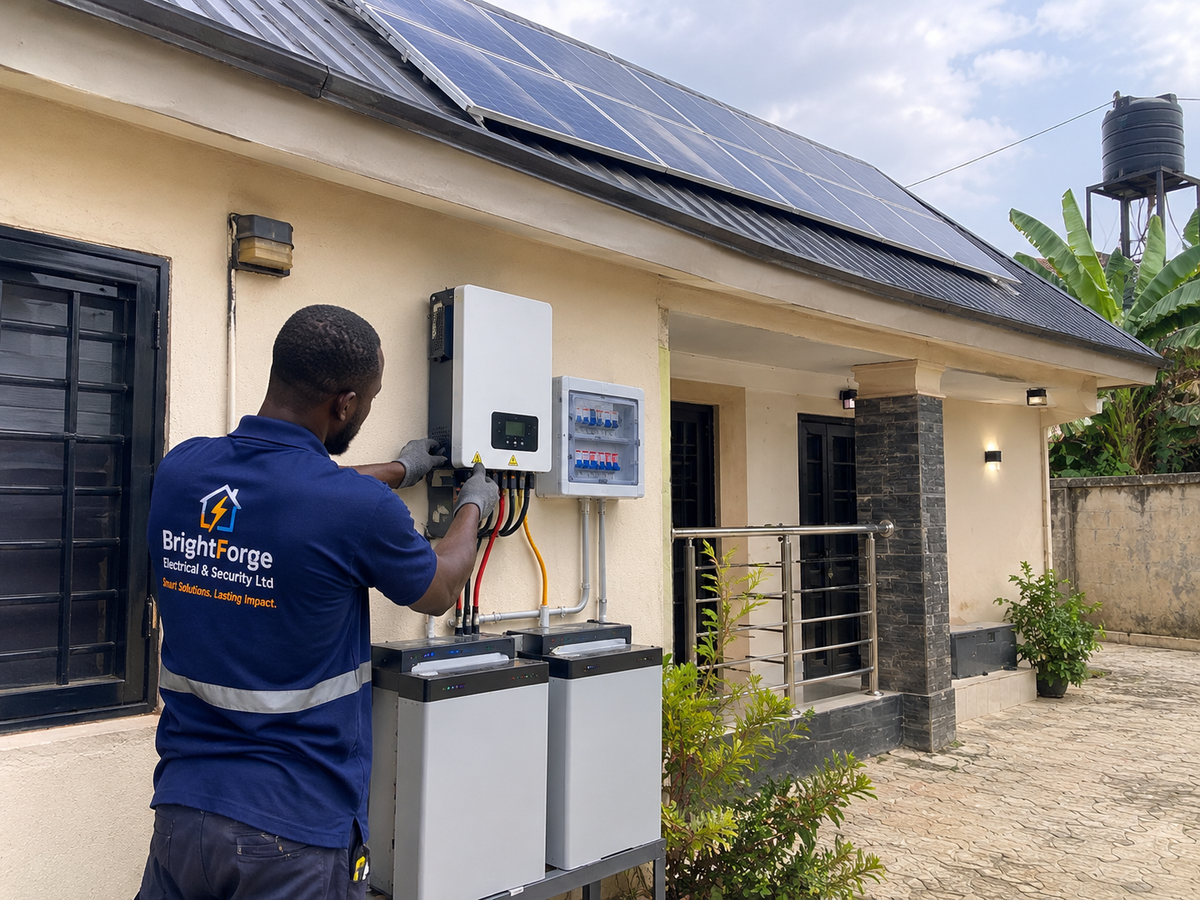
Planning to install solar power in Nigeria but unsure how much you should budget?
Whether you want to power a family home, run a shop, keep an office operational or reduce your dependence on petrol and diesel generators, understanding the cost of solar installation is an important first step.
Solar installation costs in Nigeria vary considerably. A small backup system for essential appliances will cost significantly less than a complete installation designed to power air conditioners, freezers, office equipment and other heavy electrical loads.
In this guide, we explain the estimated cost of installing solar in Nigeria in 2026, compare different system capacities, examine the equipment that makes up the total cost and explain how to determine the right system for your property.
If you are considering solar installation in Benin City, Edo State, or elsewhere in Nigeria, this guide will help you plan your budget and make a more informed decision.
How Much Does Solar Installation Cost in Nigeria in 2026?
The cost of installing a complete solar power system in Nigeria can range from a few million naira for smaller residential systems to tens of millions for larger commercial and industrial installations.
The actual price depends on the inverter capacity, battery storage, solar panel capacity, equipment quality, installation requirements and the electrical loads the system is expected to support.
The following table provides indicative market planning ranges for selected hybrid solar installations in Nigeria in 2026.
Solar system capacity | Estimated complete installation cost |
|---|---|
3kVA | ₦1.8 million – ₦4 million |
5kVA | ₦2.8 million – ₦5.8 million |
10kVA | ₦5.5 million – ₦10.8 million |
These are indicative market estimates, not fixed prices or BrightForge quotations. They are based on published Nigerian market pricing references available in October 2026. Actual quotations may fall outside these ranges depending on equipment specifications, location and project requirements.
It is also important to understand that these figures refer to complete installations, not just the price of an inverter.
A proper installation quotation should clearly identify the equipment, accessories, installation work and any additional requirements included.
What Is Included in a Complete Solar Installation?
A functional solar power system involves several components working together. Purchasing an inverter and a few solar panels does not automatically give you a properly designed solar installation.
Here are the main components to consider.
1. Solar Panels
Solar panels convert sunlight into electrical energy.
Their combined wattage determines how much solar power can be generated under suitable conditions.
For example, six 550W panels provide a combined rated capacity of 3,300W (3.3kW).
The number of panels required depends on your expected energy consumption, available sunlight, battery charging requirements and inverter specifications.
Panel prices depend on their wattage, technology, manufacturer and supplier.
2. Solar Inverter
The inverter converts direct current (DC) electricity from the battery and solar system into alternating current (AC) electricity used by most household and commercial appliances.
Hybrid inverters can work with solar panels, battery storage and, depending on the model, the public electricity supply or a generator.
The inverter must be selected according to the expected simultaneous load, surge requirements and battery compatibility.
Remember that kVA and kW are not always interchangeable. A 5kVA inverter does not necessarily deliver 5kW of usable continuous power. Always check its actual rated output.
3. Battery Storage
The battery stores energy for use when sunlight is unavailable or insufficient.
Battery capacity is measured in kilowatt-hours (kWh), while inverter capacity is commonly expressed in kilovolt-amperes (kVA).
The two measurements serve different purposes.
For example, a larger battery provides more stored energy and potentially longer backup time, but it does not automatically increase the inverter's maximum output capacity.
Common battery options include:
Lithium batteries, particularly LiFePO4.
Tubular lead-acid batteries.
Other compatible deep-cycle battery technologies.
Lithium batteries generally offer greater usable capacity, higher charging efficiency and longer cycle life than conventional lead-acid batteries, although actual performance depends on the product and operating conditions.
4. Mounting Structures and Accessories
A complete installation also requires supporting materials, including:
Solar panel mounting structures.
DC and AC cables.
Appropriate circuit breakers and isolators.
Surge protection devices.
Connectors and distribution equipment.
Earthing and bonding materials.
Battery cables and suitable protective devices.
These items are important for the safe and reliable operation of the system.
5. Installation and Commissioning
Professional installation involves mounting the panels, connecting the equipment, integrating the system with the building's electrical installation, configuring the inverter and testing the system.
The amount of work required depends on the property, cable routes, roof structure, existing electrical installation and system complexity.
A quotation should make clear whether these activities are included.
How Much Does a 3kVA Solar System Cost in Nigeria?
An installed 3kVA hybrid solar system may cost approximately ₦1.8 million to ₦4 million based on published 2026 market estimates.
This type of system may be suitable for smaller homes, flats and limited backup applications, depending on the equipment configuration.
Possible appliances include:
LED lighting.
Ceiling fans.
Television.
Laptops and phone chargers.
A suitably sized refrigerator.
Other compatible low-power appliances.
However, the appliances that can operate together depend on their combined running wattage and starting surge.
A system with a relatively small battery may provide adequate daytime support but limited backup after sunset.
If you intend to operate an air conditioner, electric iron, water heater or other heavy appliance, the system must be assessed carefully before selecting this capacity.
How Much Does a 5kVA Solar System Cost in Nigeria?
A complete 5kVA hybrid solar installation may cost approximately ₦2.8 million to ₦5.8 million in 2026.
This capacity can be appropriate for many residential properties and some small businesses, provided the inverter output, battery capacity and panel array are properly matched to the loads.
Depending on its configuration, it may support:
Lighting and ceiling fans.
Television and computers.
Refrigerators and freezers.
Internet equipment.
Selected water pumps.
Some air-conditioning loads, subject to system design.
Consider two installations:
System A: A 5kVA inverter with a 10kWh battery and 3kW of solar panels.
System B: A 5kVA inverter with a 15kWh battery and 5kW of solar panels.
Both systems have the same inverter rating, but System B has more battery storage and greater solar generation capacity.
Consequently, their costs and operating capabilities will differ.
This is why comparing solar installations using inverter capacity alone can be misleading.
How Much Does a 10kVA Solar System Cost in Nigeria?
A complete 10kVA hybrid solar installation may cost approximately ₦5.5 million to ₦10.8 million based on published 2026 planning estimates.
This capacity may be considered for:
Larger residential properties.
Homes with multiple air conditioners.
Offices and business premises.
Shops with refrigerators and freezers.
Properties with several electrical loads operating simultaneously.
However, a 10kVA inverter does not automatically guarantee that every appliance in a property can run simultaneously.
The battery storage, solar panel capacity, inverter output and starting requirements of heavy appliances must all be considered.
For commercial properties, a detailed assessment is particularly important because business operations may require longer backup periods and more predictable energy availability.
What Determines the Total Cost of Solar Installation?
Two customers can request a 5kVA solar system and receive very different quotations.
Here are some of the main reasons.
1. Your Electricity Consumption
The first consideration is what you want to power.
A home using lighting, fans, a television and a refrigerator has different requirements from a property running multiple air conditioners, pumping machines and freezers.
The more electrical energy you consume, the more generation and storage capacity you may need.
2. Battery Capacity and Technology
Battery storage is one of the major factors influencing the total cost of a solar installation.
A system designed to provide two hours of backup will have different storage requirements from one designed to support essential appliances throughout the night.
Your preferred backup duration should therefore be established before selecting a battery.
3. Solar Panel Capacity
The solar panel array determines how much energy can be generated during the day.
A larger array may help recharge batteries faster and support daytime loads, subject to available sunlight, shading, orientation and inverter input limits.
The number of panels should be determined through proper system design rather than simply choosing an arbitrary quantity.
4. Equipment Brand and Quality
Equipment prices vary according to manufacturer, specifications, warranty, availability and quality.
A cheaper inverter or battery is not necessarily the most economical choice over its useful life.
Before purchasing, confirm the manufacturer's specifications, warranty conditions, compatibility and availability of after-sales support.
5. Property and Installation Requirements
The installation location also affects cost.
For example:
Roof type and condition.
Distance between the panels, inverter and battery.
Cable routing requirements.
Existing electrical distribution arrangement.
Single-phase or three-phase supply.
Additional protection and earthing requirements.
Commercial and industrial properties may require more extensive engineering and installation work.
Residential vs Commercial Solar Installation: What Is the Difference?
Although the basic components are similar, residential and commercial solar installations often have different design requirements.
Consideration | Residential | Commercial |
|---|---|---|
Main objective | Household power and backup | Business continuity and operating costs |
Typical loads | Lights, fans, TVs, appliances | Computers, refrigeration, pumps, equipment |
Operating hours | Household usage patterns | Often extended business hours |
System design | Based on household consumption | Based on business load profile |
Installation complexity | Varies by property | Can require more extensive planning |
For residential customers, the priority may be keeping essential appliances operational during power outages.
For businesses, the priority may be maintaining operations, protecting equipment and reducing generator fuel consumption.
Neither customer should select a system based solely on the number of rooms or the size of the building.
A proper assessment of actual electrical loads is essential.
How to Choose the Right Solar System for Your Home or Business
Before committing to an installation, take the following steps.
Step 1: Identify the appliances you want to power.
List the appliances, their wattage and how many hours you expect to use each one.
Step 2: Determine which appliances operate simultaneously.
This helps establish the inverter's required output capacity.
Step 3: Decide how long you need backup power.
Your preferred backup duration helps determine the battery storage required.
Step 4: Assess your property.
The roof condition, available installation space, shading and existing electrical arrangement all matter.
Step 5: Request a properly specified quotation.
Ask for the inverter rating and output, panel capacity, battery capacity, protection equipment, installation scope and warranty information.
Step 6: Compare quotations based on specifications.
Do not choose an installer simply because their total price is lower. Compare what each quotation actually includes.
You can start by using the BrightForge Solar & Energy Needs Estimator to obtain a preliminary recommendation based on your appliances.
Try the BrightForge Solar Estimator
Is Solar Installation Worth the Investment in Nigeria?
For many households and businesses, solar can offer practical benefits beyond simply having electricity during public supply interruptions.
These include:
Reduced dependence on petrol and diesel generators.
Less exposure to generator fuel and maintenance expenses.
Quieter operation.
No direct exhaust emissions during normal solar operation.
Greater control over when and how electricity is used.
Potentially lower long-term operating costs.
However, whether solar is financially worthwhile depends on the initial investment, electricity consumption, generator usage, battery replacement costs, equipment lifespan and maintenance.
A properly sized system is more likely to deliver value than one purchased simply because it has a high inverter rating.
Solar should be treated as a long-term energy investment, not just an emergency backup purchase.
Why Professional Solar Installation Matters
A solar system involves electrical equipment operating at potentially hazardous DC and AC voltages.
Incorrect cable sizing, poor connections, inadequate protection, improper earthing and incompatible components can create serious safety and reliability problems.
A professional installation should consider:
Appropriate cable sizing and current ratings.
DC and AC isolation and protection.
Surge protection where required.
Proper earthing and bonding.
Correct inverter and battery configuration.
Suitable panel mounting and weather protection.
Testing and commissioning.
In Nigeria, NEMSA has statutory responsibilities for enforcing technical standards and regulations and for inspection, testing and certification of electrical installations.
Customers should take electrical installation safety seriously and confirm the applicable inspection and certification requirements for their project.
Looking for Solar Installation in Benin City or Elsewhere in Nigeria?
Whether you need solar power for your home, office, shop or another property, the right starting point is understanding your actual electricity requirements.
BrightForge Electrical & Security Ltd provides solar installation services involving the assessment of electrical loads, solar panel mounting, inverter and battery installation, and integration with existing electrical systems.
Based in Benin City, Edo State, BrightForge primarily serves Benin City while considering suitable projects and enquiries from other parts of Nigeria, subject to project scope and location.
Our approach is straightforward:
Tell us about your property and electricity requirements.
We assess your needs and determine the appropriate installation scope.
We prepare a quotation for your review.
Once approved, the installation is scheduled and carried out.
Ready to find out how much solar installation will cost for your property?
You don't need to guess your inverter size or spend money on equipment before understanding what your property requires.
Use our free Solar & Energy Needs Estimator for a preliminary assessment, or contact BrightForge directly to discuss your installation.
Calculate Your Solar Requirements
Request a Solar Installation Quote
Speak with BrightForge on WhatsApp
BrightForge Electrical & Security Ltd
Smart Solutions. Lasting Impact.
Frequently Asked Questions About Solar Installation Costs in Nigeria
1. How much does it cost to install solar in Nigeria in 2026?
A complete 3kVA system may cost approximately ₦1.8 million–₦4 million, a 5kVA system ₦2.8 million–₦5.8 million, and a 10kVA system ₦5.5 million–₦10.8 million. These are indicative market estimates, not fixed quotations.
2. How much does a 5kVA solar system cost in Nigeria?
A complete 5kVA hybrid solar installation may cost approximately ₦2.8 million–₦5.8 million in 2026. Battery storage, solar panel capacity, equipment quality and installation requirements determine the final price.
3. Is a 5kVA solar system enough for a three-bedroom house?
It may be sufficient for a three-bedroom house running essential appliances such as lights, fans, a refrigerator and television. However, multiple air conditioners and other heavy appliances may require a larger system.
4. How many solar panels do I need for a 5kVA inverter?
There is no universal panel count. The required solar array depends on the inverter's permitted solar input, battery charging requirements, energy consumption and available sunlight. The inverter manufacturer's specifications should guide the design.
5. How long can a solar battery last?
Backup duration depends on the battery's usable capacity and the electrical loads connected to it. Battery lifespan also depends on its chemistry, quality, temperature, charging conditions and usage.
6. Is lithium better than lead-acid batteries for solar?
Lithium batteries, particularly LiFePO4, generally offer higher usable capacity and longer cycle life. Lead-acid batteries may have a lower initial purchase price, but their usable capacity and replacement frequency should be considered when comparing long-term costs.
7. Can solar power run an air conditioner?
Yes, provided the inverter, battery and solar panel system are appropriately sized for the air conditioner's running power and starting requirements. The number of air conditioners and hours of operation will significantly affect the system design.
8. Can solar power run a business?
Yes. Solar installations can support shops, offices and other business premises. The system must be designed around the business's electrical loads, operating hours and backup requirements.
9. Does solar installation include wiring and electrical protection?
A complete installation should account for the necessary cables, connectors, isolation, circuit protection, surge protection and earthing. However, the exact scope varies, so customers should confirm these items in their quotation.
10. How do I get a solar installation quotation in Benin City?
You can contact BrightForge Electrical & Security Ltd in Benin City through the website's quotation page or WhatsApp. Provide your location, the appliances you want to power and your preferred backup duration to help us understand your requirements.
Final Note
Solar installation prices and equipment availability change over time. Treat the figures in this guide as budgeting estimates and obtain an updated, itemised quotation before purchasing equipment or commencing installation.
Need a solar solution for your property? Contact BrightForge Electrical & Security Ltd to discuss your requirements.
Need help with this at your property?
Tell us what you need and we'll get back to you during business hours. (Monday–Saturday, 8:00 AM–6:00 PM)